Labels

Saturday, May 13, 2017

Baking with Baking Soda!

In our second unit cooking in Food, we did a lab report on experimenting the different types of leavening agents, such as biological leavening agents and biological leavening agents. In order to experiment with the different types of leavening agents, we split up into groups of 3. The most challenging part for me was the test. I tend to freak out about test and timing frames but turns out to get a good grade. One thing I would be proud of is how our bread turned out knowing it was delicious.

Leavening Agents Experiment
Food AP2
5/13/17
Group: Baking soda
partners: RP, EM

For this experiment, we tested different types of leavening agents such as baking soda, sourdough, and yeast.  Leavening agents is a substance creating the dough expansion by releasing gases within the mix. Baking soda and sourdough are chemical leavening agents which would make them experimental groups as they have been chemically altered to rise faster. In order for baking soda to work properly, it must be used with another acidic ingredient such as buttermilk. Yeast would be used as our controlled group knowing it is a biological leavening agent. This means it is a natural leavening agent that may take longer to rise as it ferments the sugars in the food that create carbon dioxide.


Which leads us to our question, Which leavening agent will leaven the bread higher? My hypothesis was baking soda will rise higher. The reason behind this would be when I think of baking I associate baking soda with it from all the previous recipes I've seen.


Ingredients:
Sourdough:

4 cups water
10 cups flour
3.5 tbsp salt
¾ cup sourdough starter

Yeast:

3 Cups Lukewarm Water
6.5 to 7.5 cups of All Purpose Flour
1 Tbsp salt
1.5 Tbsp Dry or Active Yeast

         Baking Soda:

3.5 cups flour
2 cups buttermilk
1 tsp sugar
1 tsp baking soda
1 tsp salt

Procedure:


Sourdough:

  1. Combine all the ingredients except salt
  2. Let the dough sit for 15-60 minutes
  3. Add salt
  4. Knead dough for 10 to 15 minutes
  5. keep the dough at room temperature for 4-6 hours
  6. Slit the top and bake for 1 hour
  7. Let sit to cool then slice


Yeast:

  1. Mix all the needed ingredients for the dough
  2. Cover the bowl and let it sit for 2 hrs in room temperature to rise
  3. Refrigerate for 2 hours
  4. Make loaf and let it rise again for 1 hour
  5. Slit top of the bread and bake for 25-35 minutes at 450 (temp)
  6. Let it sit to cool and slice


Baking Soda:
  1. Combine all dry ingredients
  2. Pour in the buttermilk
  3. Gently mix ingredients
  4. Take out the bowl and shape it into a ball making sure not to knead it
  5. Cut an x on the top
  6. Bake for 40-50 minutes
  7. Let it sit to cool and enjoy a slice
Calculations:

Baking soda: 
  No calculations needed because the recipe had the perfect serving size amount

Yeast: The yeast bread was done 1/4 of the recipe by multiplying all the ingredients by .25

  3 x .25 = ¾ cup
  7 x .25 = 1 ¾ cup
  1 x .25 = ¼ tbsp
  1.5 x .25 = ⅜ tbsp

Sourdough: The sourdough bread was 1/4 of the recipe
  3 x .25 = ¾ cup
  7 x .25 = 1 ¾ cup
  1 x .25 = ¼ tbsp
  1.5 x .25 = ⅜ tbsp


Variable
Control Group
(Commercial Yeast Bread)
Experimental Group 1 (Sourdough)
Experimental Group 2 (Commercial Leavening Agent Bread)
Flour type
Same

same
Same
Dough rise time
2 hrs at room temperature and 2 hrs-7 days in the refrigerator
15-60 minutes
5 minutes
Oven temperature
450 F
500 F
450 F for 15 minutes, then 400 F for 20-30 minutes more
Bake time
25-35 minutes
2 hours
40 minutes
Dough amount
¼ of recipe
¼ of recipe
Full recipe
Other
N/A

N/A
buttermilk


Nutrition: My group calculated the nutrition information for baking soda by finding the the serving in each ingredient we used then added it all up together.
  •   Calories 1400+240=1640. 66% of your daily usage nutrition. (= 1640/2500)
  •   Carbohydrates 4 g from sugar + 322 g from flour + 24 g from buttermilk = 350 g 88% of my daily usage nutrition. (= 350/400)
  •   Fat 6 g. 7% of our daily usage. (= 6/78)
  •   Protein 50 g. 89% of my daily usage nutrition. (= 50/56)
Analysis: Yeast: The yeast bread lead up to be the only bread that was not burnt. It had the perfect amount of fluff and crust. The before and after height change was 48.1% which went from being 3" tall to 4" tall.


Sourdough: The sourdough bread turned out to be in the last place from the tasting department as it was completely burnt from the outside and raw on the inside. The cause of this might be from the technique used to knead. The before and after height change was decreased by 18.2%.


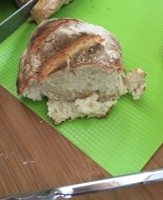
Baking soda: I I would say my group loaf of bread was the better tasting and the highest results in the height by 62.5%. The outer part of the bread was had a strong crunch which is personally my favorite. The baking soda was better from the sugar and buttermilk as it added a nice fluff and sweetness to it.

:This bar graph shows the before and after height difference in inch:
GA "Leavening Agents" (2017)

Overall my hypothesis was slightly right. The yeast bread increased the most in height but did not expand as much as experimental group 1 and 2 in width or length. The baking soda bread grew the most in height but didn’t change in width or length. The sourdough rose the most in all aspect but was smaller than the other bread.

Yeast:
IMG_0070.jpg
GA "yeast bread" (2017)
Sourdough:


Displaying 20170511_121135.jpg
GA "sourdough bread" (2017)

Baking Soda:
IMG_0067.jpg
GA "baking soda bread" (2017)


Wednesday, May 3, 2017

Hi, my name is Onion Onion

In this unit Food for Thought, we learned about the origin and value of food. We were able to choose any crop of our choice and reflect it to our own family recipes. I choose an onion because my family always have onion as an important topping to any of our foods and personally I just love it. The video you will about to see will be an interpretation of brown onion perspective in the first person and several intentional puns.


Cited Work:
The National Onion Association. N.p., n.d. Web. 03 May 2017.

Thursday, April 27, 2017

Know To Grow!

In our first unit Food, our first action project was about "planting" our own garden from all the earlier information we have learned. We learned about how plants grow, what makes up good and bad companions, biodiversity, and the iterations of organisms.


GA, My Plantation, 2017 
The value I had for gardening and just another living organism has changed over time in this unit. I learned the rules and skills you need to carry to grow a garden. I also learned the several different ways to grow plants rather it be inorganic or organic. The place I choose to place 10 plants was in my backyard. On the right side, there is a fence which may help out when the crops start to sprout it will use a leverage for growth. The plants will grow in a column like station knowing that is the previous space my family uses for growing other crops which made it idealistic to place. The space measured out 3 square by 6 square with a total of 18 ft squared. Next, I placed 3 Tupperware which measured as h=6 in and l= 4.5 w= 5 with a total of 120 in cube each. The plants I decided to grow was cucumbers, parsnip, peas, potatoes, pumpkin, beans, celery, corn, radish, and dill. If I was to grow the peas and potatoes next to each other instead far apart it will cause a bad companion and cause a relation of competition knowing they will fight for survival such as sunlight, nutrients, and space.

My nitrogen levels were at a medium level which means I would have to apply a moderate amount of fish meal to my soil. I chose fish meal because it was a light enhancement. The meal is 4 lbs per 100 sq ft. I first had to calculate my square footage. My nitrogen turned out 1.38 and as for my potassium, it was 307 as it did not need any further calculations and as for phosphorus, it turned out to 2.78.

In this unit, we also read a book called One Straw Revolution and a reflection on Fukuoka practices of farming and how they differ from the norm of agriculture. Fukuoka practiced natural farming which included no pesticides, herbicides, mechanical plowing, and chemical fertilizer. Comparing this to my garden I can say I will not need to do most of these things knowing I have such a small space and using too much can drown the plants into a lot of absorbent of unnecessary chemicals which means I will use his practices on natural farming by leaving it to nature.

Overall I can say this unit Really opened my eyes to find out how fragile everything really is and how easy it is for organisms to develop unbalanced. I also learned That everything on this Earth has a purpose in life in a way that we help each other out to grow and keep surviving as a balanced community similar to what Fukuoka has stated

Thursday, March 30, 2017

My M.A.G.I.C. Plan

In this elective term M.A.G.I.C. I learned several qualities of "successful people and the "successful" journey I will take. In the begging of this class, we identified what success means to us and my definition of success would be being sustained and fulfilled. Throughout this class we had multiple people come in and talk about their journey of the profession they have whether it was a UIC women's soccer coach, politician, life coach, a mentor, or a poet. I grasped a lot of information from the people and put it in terms of what I want to do for my personal journey. My Influencer was Stephen King who is an author of several horror novels. The reason I choose him as an influential person because his skill to bring word to life in a thrilling way is admiring. Last but not least my M.A.G.I.C. plan is being a film director.

Sunday, February 26, 2017

Dreamcatchers

For my second unit in Who am I we learned about dreams. In this class we analyzed our unconscious and consciousness mind and the affects it has on dreams. We learned about the Freud theory which consist the id, ego, and superego. With this information we learned how and what is pathologist. In this process we learned the definition and meaning behind making a dream catcher. As we created our own into our own definition.

GA, Dream Catcher, (2017)

      This is a wide shot of my dream catcher it is meant to catch bad dreams and let the good dreams pass through. It advocates positive sleep, that were created by Native Americans. It lets the good dreams pass through the circle and then flow down the string into the individual. The bad dreams are caught in the circle and then they disappear when the sun rises up. The hoop of the dream catcher indicates strength and the center of the hoop means your bliss. The center of your dream catcher often is something that makes you happy. My bliss would be G-D. This symbolizes my religion which is catholic and the strong connection I have with my belief. For the hoop I wrapped it with yellow and blue pipe cleaners because they are my favorite colors. They symbolize harmonize, sooth, creativity, power, energy which is what I want to keep in my dreams. I also brought white thread in the center of my dream catcher. It symbolizes the good and the bad, such as positiveness, emptiness, open-minded, darkness, and uncontrollable. As I sleep I like to experience everything rather that is good and bad dreams as I believe they both have a powerful meaning.

GA, close up of the Dream Catcher, (2017)
      One dream that affects my dream catcher is me getting kidnapped. In this dream I had to go through games and levels to no get caught. I this dream I did not feel scared rather happy of getting kidnapped. At the end I lost and got robbed I woke up before I can see what would happen to me. The blue and yellow both have the same meaning which is the joy and rush I felt completing each level. The white thread represents how clueless and curious I was to finding out what will happen next as I didn't knew f it was good or bad.

    In the bottom of my hoop it represents togetherness. The blue strings started of as 3 individual string but as I connect them in a braid. This represents how each individual can bring there strengths to the table and share within a group to success. If I was able to ask this dream any question I wouldn't. The thing I like about my dream is how I try figure out the meaning and why I had it. So if I was to ask it a dream I would know the answer which is what I don't want. If I was able to go back to this dream I would like to have undone choices that made it harder for them to catch me. For example, I chose to help a little girl from a kidnapper and take the journey with me. If I was able to go back I would of left her behind as she nearly killed me.

Thursday, February 23, 2017

My Solution to Pollution

As I end Fuel with the 3rd and last action project I introduce to you "My solution to pollution". In this course we learned about the impact pollution has on yourself and the world around you. In this project we learned how much we and our neighborhood pollute. While we learned the impact and importance of pollution we also learned ways to improve our choices to decrease our carbon footprint and what actions we can take to decrease the global carbon ppm. One of the challenges I faced was balancing chemical bonds. Something that I am proud of is the knowledge I gained in terms of knowing how severe pollution really is.

Tuesday, February 7, 2017

Hydroelectric Is Your New Investment

In our course Fuel we are making a renewable energy infomercial of our chosen energy source. I picked Hydroelectric, and in this infomercial I talk about the advantages, disadvantages, and business who uses this energy source. Once I found out how much a hydro plant costs to built and its annual savings I was able to turn it into a function to find out how many years it will take to make a profit. The most challenging part for me was being able to record the audio to my presentation. What I am most proud of is what I have learned in this course. I learned about functions, types of energy, and nonrenewable/renewable sources.  

<