Labels

Wednesday, September 20, 2017

Little Crawling Creatures


For the first action project in my STEAM course called population, we will be diving into animal taxonomy, specifically one of my choices. I decided to study and learn more about black ants. In doing this, I will be looking at their taxonomy chart and I will be making statements using set theory, a language used to describe groups in a mathematical way. I wanted to choose an ant because I wanted to learn something new about ants knowing they’re everywhere and we never stop and observe their habitat or daily obstacles. On this FE I unfortunately was not able to find any ants but I did venture out into the reptile section thinking they would be hanging out there. Unfortunately i was not able to find any at the zoo but I did search up some videos to get close up observation of my own.

The organism that I picked was Lasius niger or commonly known as the Black ants. Black ants are the most harmless common ants as they are all around you, just very tiny. Although the habitat of the black ants can be a wide range of places, they are usually found in garden species, dry areas, and wet areas. A black ant’s diet can consist of several things such as fruit, leftovers, seeds, and other small insects. Black ants are harmless to humans but when it comes to taking care of their territory they can bite but might not do much harm.

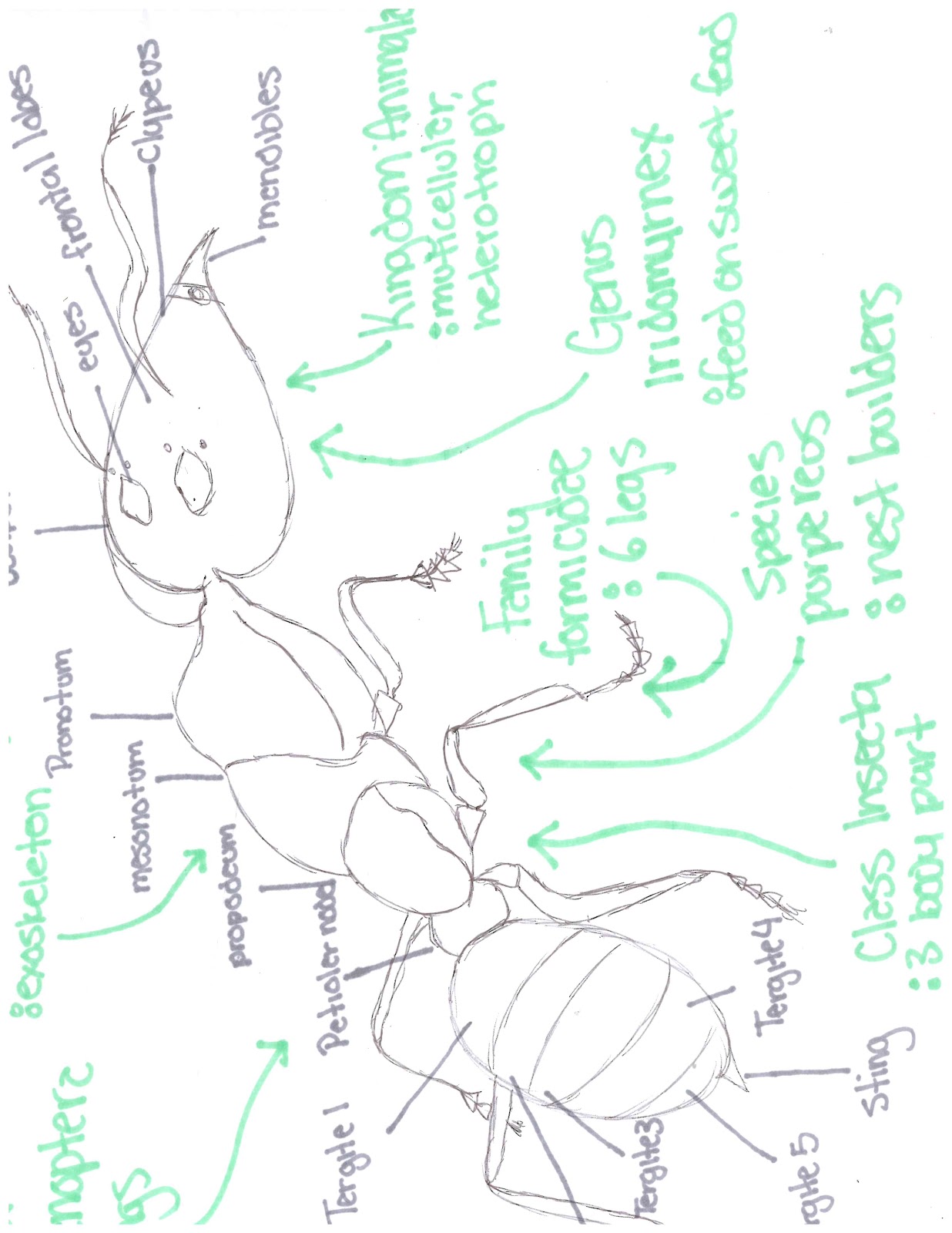
Taxonomy order of Black ants

TAXONOMY LEVEL
CLASSIFICATION OF YOUR ORGANISM
PHYSICAL DESCRIPTION OF THIS CLASSIFICATION
Kingdom
Animaliamulticellular, heterotrophs 
Phylum
Arthropodaexoskeleton, invertebrate 
Class
Insectathree body part, compound eyes 
Order
Hymenopteraherbivorous, wings
Family
Formicidae6 legs, stinger
Genus
Lasius rainbow ant native to Australia, feed on sweet food
Species
nigernest builders, colored appearance 


doc07104220170921114848_001 (1).jpg
GA, Ant Taxonomy, 2017

“North American Ants.” North American Ants, 5 Aug. 2017


Venn diagram comparison

I was pared up with 2 classmates to compare there organism characteristics which was a meerkat and a african lion. By doing this we all got together to give each other traits of our animal for the venn diagram.When you think about meerkats, Black Ants, and African lions you might not be able to make a comparison from the top of your head knowing they are all distinctively different. One thing they all had in common was the kingdom which was Animalia and they can all sexual reproduce. African lions and meerkat both have sharp teeth small ears and have fur, unlike the black ant. Overall I observed that the African lion and the meerkat had more similarities than black Ant which made sense knowing I was comparing different sets of class.


                                               GA, Venn diagram comparison, 2017

Set theory statements

These statements represent mathematical statements that describe the population of black ants.

M= meerkat, B= Black ant, A= African lion


  • M ∈ M : Meerkats is an element of Mammals
  • Flying ∉ (m U b) : flying is not a element of meerket and black ants. 
  • Animalia ∈ A : anamalia is a element of African lion
  • A ∩ M= {claws, sharp teeth, meat eaters}
  • reptile ∉ B : reptile is not a element of a black ant

In conclusion, this action project has allowed me to analyze an organism better by doing physical observations, comparisons to other kingdoms, and understanding the mathematical language using set theory. My taxonomy chart was the task that I was most impressed with. The black ant taxonomy chart was impressive because it was the hardest task for me because of all the really long definitions insects have. Learning set theory was like a fun game of speaking in secret code strangely. Throughout the unit, I felt confident which was new to me because math is not my strongest subject but I really pulled through this AP where I understood everything that was going on in class without feeling overwhelmed. Last but not least this AP was a fun way to learn about different organism in their natural habitat.

Works Cited:

“North American Ants.” – North American Ants, 5 Aug. 2017, www.myrmecos.net/north-american-ants/. Accessed 21 Sept. 2017.

“Small black ant videos, photos and facts.” Arkive, www.arkive.org/small-black-ant/lasius-niger/. Accessed 21 Sept. 2017.

Sunday, June 4, 2017

Genesis's Food Review

On our third unit of food for thought, we were asked to be in the mindset of a reviewer, more importantly, a food reviewer of our chosen dish. I chose to analyze ceviche as it is a versatile dish that is easy to make and enjoy any time of the day.

Welcome to Genesis's Food Second Thought

Hello, fellow food eaters, today we will be reviewing the inquisitive flavor of ceviche. We will take on the fight of a home cooked ceviche made by the one and only (me) and ceviche from a Mexican restaurant called the "El Burrito Jr."
DS "Bomb.com  Ceviche" 2017


My ingredients:
  • Tilapia: .5 pound
  • Tomatoes: 1
  • Onions: half of 1
  • Cilantro: 3
  • Lime Juice: 1 1/4 cups

Presentation rate: 3/5
The presentation was not appealing to the eye from the drenched juice that was balled up in the boring container. As they say, don't judge the book by it's the cover.

Taste rate: 5/5
The mouthwatering acting up quenched my thirst with a mix of lime juice and tilapia juice melting in my mouth with a soft crunch of white onions including an earthy kick of cilantro with a small hint of sweetness of the tomatoes. 


Texture rate: 4.5/5
The texture was really spongy with the lightweight chew of every ingredient. The longer it sit on the container the more infused it got making it the same consistency. Overall I rated it a 4.5 considering to my liking I like ceviche to fall in mouth making it easy to chew to be able to savor and enjoy most of the flavor.


GA "amazing ceviche" 2017
El Burrito Jr." ingredients:
  • Tilapia
  • Lime: 2
  • Cucumbers
  • Tomatoes
  • Tostada: 1
  • Cilantro

Presentation rate: 5/5
The presentation was aesthetically pleasing to the eye. This gave a more clean look to the dish adding a tostada. Overall the presentation was good quality.

Taste rate: 4/5
I was very disappointed knowing I set high bars from the presentation. The saying don't judge a book by it's cover definitely followed into this category too. The ceviche had the lime optional making the cucumber the ingredient that makes the dish sour. The tilapia was also cut in bigger pieces from the tomatoes, onions, and cilantro making it a overpowered by other ingredients. I personally like a balanced variety of ingredients to be able to savor each flavor and sadly I was not able to say that for this dish. Even though it was not to might liking I will still recommend you purchasing  just to have an idea of what you might or might not prefer to add in your ceviche.

Texture rate: 4/5
The texture was dense with the chunks of cucumber and fish. It wasn't a sharp of a taste knowing they used lime instead of processed lime juice. Once it hit your mouth it was a smooth feel from it being watery.

Both of these dishes were made from fresh ingredients knowing it only consist of fish and vegtables but they were definitely not organic. Knowing making ceviche is really versatile to the persons liking rather it be the acidic, sweet, or an earthy feel it really does not matter rather it is organic or non. I personally think non organic vegetables are more convenient and cheaper for me which is why I choose it but there should be no reason why you cant use organic products. 

The relation i would reflect my dish with 5 food transformation would be quantity over quality. Restaurants like "El BurritoJr." may not cater to the individual liking of a dish like ceviche knowing they care more about efficiency which follows into the category of quantity. Versus making the ceviche yourself you really get a wide variety of ingredients of your choice. Many consumer may enjoy the fact they know where their products came from.

In conclusion ceviche is very versatile to the consumers liking. I would recommend you to make it at home knowing you get a bigger portion and satisfaction knowing you know it will be good and a light weight dish to eat at any time of the day.

GMOs are the Way to Ho!

On our third unit of Food we did a debate on GMOs. In this presentation I show the reasons on why I am pro GMO including the reasons on why you should too. A challenge I faced doing this action project is the rebuttal. Finfing a strong argument on how GMOs does not cause health benefits


Tuesday, May 23, 2017

Threat to the World!

In my second unit Death in our class Food for Thought, I made a video discussing how monoculture is the biggest threat to the global food system.


Works Cited:

"Bee collapse is the result of their enslavement in industrial monocultures." The Ecologist. N.p., 28 Apr. 2015. Web. 23 May 2017.

"How do monocultures influence bee health? (John Tooker Lab)." John Tooker Lab (Penn State University). N.p., 02 Aug. 2014. Web. 23 May 2017.

"6 Problems with Monoculture Farming." Regenerative. N.p., 16 Dec. 2016. Web. 23 May 2017.

Saturday, May 13, 2017

Baking with Baking Soda!

In our second unit cooking in Food, we did a lab report on experimenting the different types of leavening agents, such as biological leavening agents and biological leavening agents. In order to experiment with the different types of leavening agents, we split up into groups of 3. The most challenging part for me was the test. I tend to freak out about test and timing frames but turns out to get a good grade. One thing I would be proud of is how our bread turned out knowing it was delicious.

Leavening Agents Experiment
Food AP2
5/13/17
Group: Baking soda
partners: RP, EM

For this experiment, we tested different types of leavening agents such as baking soda, sourdough, and yeast.  Leavening agents is a substance creating the dough expansion by releasing gases within the mix. Baking soda and sourdough are chemical leavening agents which would make them experimental groups as they have been chemically altered to rise faster. In order for baking soda to work properly, it must be used with another acidic ingredient such as buttermilk. Yeast would be used as our controlled group knowing it is a biological leavening agent. This means it is a natural leavening agent that may take longer to rise as it ferments the sugars in the food that create carbon dioxide.


Which leads us to our question, Which leavening agent will leaven the bread higher? My hypothesis was baking soda will rise higher. The reason behind this would be when I think of baking I associate baking soda with it from all the previous recipes I've seen.


Ingredients:
Sourdough:

4 cups water
10 cups flour
3.5 tbsp salt
¾ cup sourdough starter

Yeast:

3 Cups Lukewarm Water
6.5 to 7.5 cups of All Purpose Flour
1 Tbsp salt
1.5 Tbsp Dry or Active Yeast

         Baking Soda:

3.5 cups flour
2 cups buttermilk
1 tsp sugar
1 tsp baking soda
1 tsp salt

Procedure:


Sourdough:

  1. Combine all the ingredients except salt
  2. Let the dough sit for 15-60 minutes
  3. Add salt
  4. Knead dough for 10 to 15 minutes
  5. keep the dough at room temperature for 4-6 hours
  6. Slit the top and bake for 1 hour
  7. Let sit to cool then slice


Yeast:

  1. Mix all the needed ingredients for the dough
  2. Cover the bowl and let it sit for 2 hrs in room temperature to rise
  3. Refrigerate for 2 hours
  4. Make loaf and let it rise again for 1 hour
  5. Slit top of the bread and bake for 25-35 minutes at 450 (temp)
  6. Let it sit to cool and slice


Baking Soda:
  1. Combine all dry ingredients
  2. Pour in the buttermilk
  3. Gently mix ingredients
  4. Take out the bowl and shape it into a ball making sure not to knead it
  5. Cut an x on the top
  6. Bake for 40-50 minutes
  7. Let it sit to cool and enjoy a slice
Calculations:

Baking soda: 
  No calculations needed because the recipe had the perfect serving size amount

Yeast: The yeast bread was done 1/4 of the recipe by multiplying all the ingredients by .25

  3 x .25 = ¾ cup
  7 x .25 = 1 ¾ cup
  1 x .25 = ¼ tbsp
  1.5 x .25 = ⅜ tbsp

Sourdough: The sourdough bread was 1/4 of the recipe
  3 x .25 = ¾ cup
  7 x .25 = 1 ¾ cup
  1 x .25 = ¼ tbsp
  1.5 x .25 = ⅜ tbsp


Variable
Control Group
(Commercial Yeast Bread)
Experimental Group 1 (Sourdough)
Experimental Group 2 (Commercial Leavening Agent Bread)
Flour type
Same

same
Same
Dough rise time
2 hrs at room temperature and 2 hrs-7 days in the refrigerator
15-60 minutes
5 minutes
Oven temperature
450 F
500 F
450 F for 15 minutes, then 400 F for 20-30 minutes more
Bake time
25-35 minutes
2 hours
40 minutes
Dough amount
¼ of recipe
¼ of recipe
Full recipe
Other
N/A

N/A
buttermilk


Nutrition: My group calculated the nutrition information for baking soda by finding the the serving in each ingredient we used then added it all up together.
  •   Calories 1400+240=1640. 66% of your daily usage nutrition. (= 1640/2500)
  •   Carbohydrates 4 g from sugar + 322 g from flour + 24 g from buttermilk = 350 g 88% of my daily usage nutrition. (= 350/400)
  •   Fat 6 g. 7% of our daily usage. (= 6/78)
  •   Protein 50 g. 89% of my daily usage nutrition. (= 50/56)
Analysis: Yeast: The yeast bread lead up to be the only bread that was not burnt. It had the perfect amount of fluff and crust. The before and after height change was 48.1% which went from being 3" tall to 4" tall.


Sourdough: The sourdough bread turned out to be in the last place from the tasting department as it was completely burnt from the outside and raw on the inside. The cause of this might be from the technique used to knead. The before and after height change was decreased by 18.2%.


Baking soda: I I would say my group loaf of bread was the better tasting and the highest results in the height by 62.5%. The outer part of the bread was had a strong crunch which is personally my favorite. The baking soda was better from the sugar and buttermilk as it added a nice fluff and sweetness to it.

:This bar graph shows the before and after height difference in inch:
GA "Leavening Agents" (2017)

Overall my hypothesis was slightly right. The yeast bread increased the most in height but did not expand as much as experimental group 1 and 2 in width or length. The baking soda bread grew the most in height but didn’t change in width or length. The sourdough rose the most in all aspect but was smaller than the other bread.

Yeast:
IMG_0070.jpg
GA "yeast bread" (2017)
Sourdough:


Displaying 20170511_121135.jpg
GA "sourdough bread" (2017)

Baking Soda:
IMG_0067.jpg
GA "baking soda bread" (2017)


Wednesday, May 3, 2017

Hi, my name is Onion Onion

In this unit Food for Thought, we learned about the origin and value of food. We were able to choose any crop of our choice and reflect it to our own family recipes. I choose an onion because my family always have onion as an important topping to any of our foods and personally I just love it. The video you will about to see will be an interpretation of brown onion perspective in the first person and several intentional puns.


Cited Work:
The National Onion Association. N.p., n.d. Web. 03 May 2017.

Thursday, April 27, 2017

Know To Grow!

In our first unit Food, our first action project was about "planting" our own garden from all the earlier information we have learned. We learned about how plants grow, what makes up good and bad companions, biodiversity, and the iterations of organisms.


GA, My Plantation, 2017 
The value I had for gardening and just another living organism has changed over time in this unit. I learned the rules and skills you need to carry to grow a garden. I also learned the several different ways to grow plants rather it be inorganic or organic. The place I choose to place 10 plants was in my backyard. On the right side, there is a fence which may help out when the crops start to sprout it will use a leverage for growth. The plants will grow in a column like station knowing that is the previous space my family uses for growing other crops which made it idealistic to place. The space measured out 3 square by 6 square with a total of 18 ft squared. Next, I placed 3 Tupperware which measured as h=6 in and l= 4.5 w= 5 with a total of 120 in cube each. The plants I decided to grow was cucumbers, parsnip, peas, potatoes, pumpkin, beans, celery, corn, radish, and dill. If I was to grow the peas and potatoes next to each other instead far apart it will cause a bad companion and cause a relation of competition knowing they will fight for survival such as sunlight, nutrients, and space.

My nitrogen levels were at a medium level which means I would have to apply a moderate amount of fish meal to my soil. I chose fish meal because it was a light enhancement. The meal is 4 lbs per 100 sq ft. I first had to calculate my square footage. My nitrogen turned out 1.38 and as for my potassium, it was 307 as it did not need any further calculations and as for phosphorus, it turned out to 2.78.

In this unit, we also read a book called One Straw Revolution and a reflection on Fukuoka practices of farming and how they differ from the norm of agriculture. Fukuoka practiced natural farming which included no pesticides, herbicides, mechanical plowing, and chemical fertilizer. Comparing this to my garden I can say I will not need to do most of these things knowing I have such a small space and using too much can drown the plants into a lot of absorbent of unnecessary chemicals which means I will use his practices on natural farming by leaving it to nature.

Overall I can say this unit Really opened my eyes to find out how fragile everything really is and how easy it is for organisms to develop unbalanced. I also learned That everything on this Earth has a purpose in life in a way that we help each other out to grow and keep surviving as a balanced community similar to what Fukuoka has stated